

Purpose Jam Reflections: Building What Comes Next
Initial reflections on a national convening focused on purpose cultivation from Purpose Commons' Executive Director.


A week after the Purpose Jam, I’m still energized, humbled, and deep in sense-making mode.
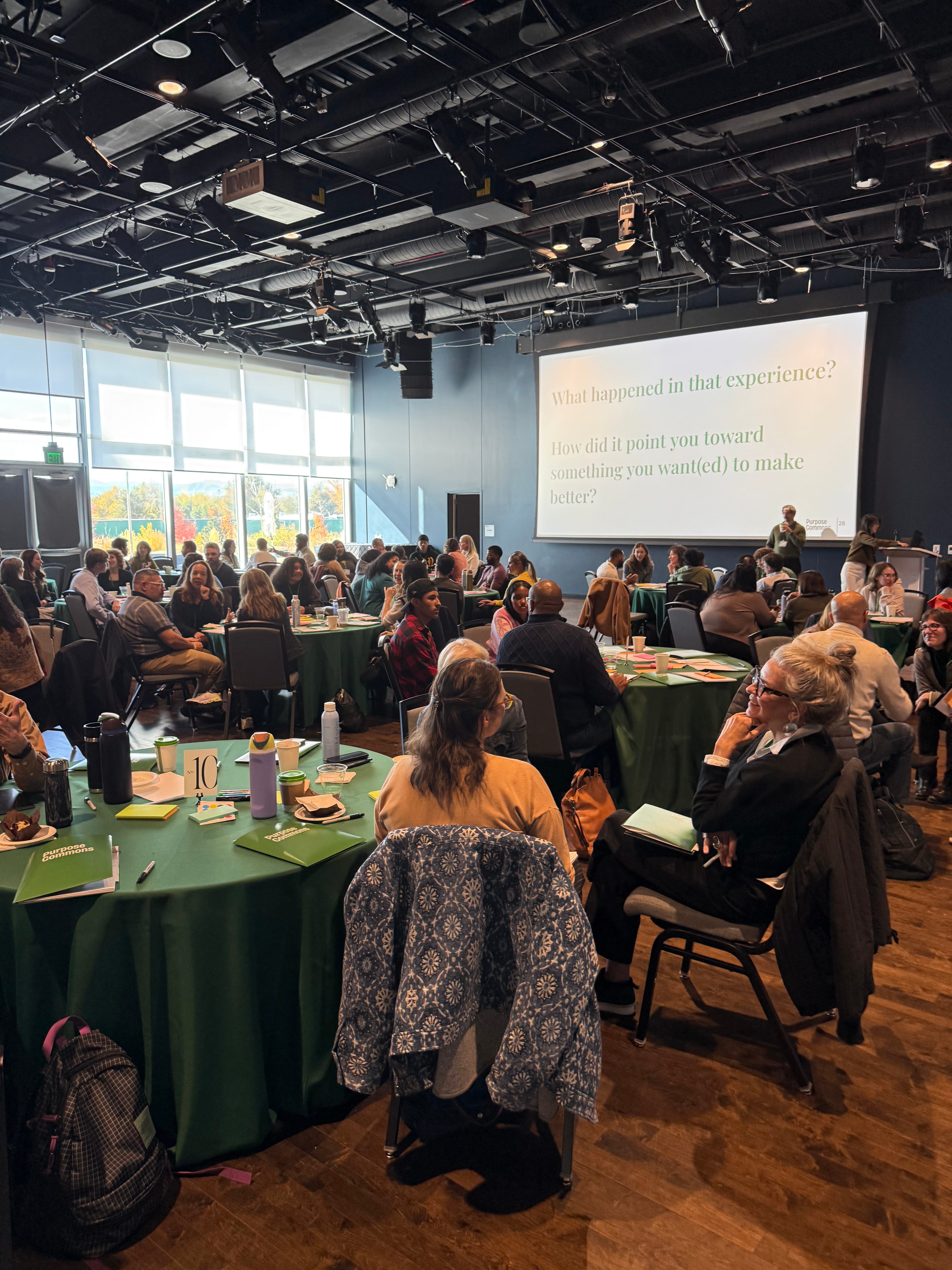
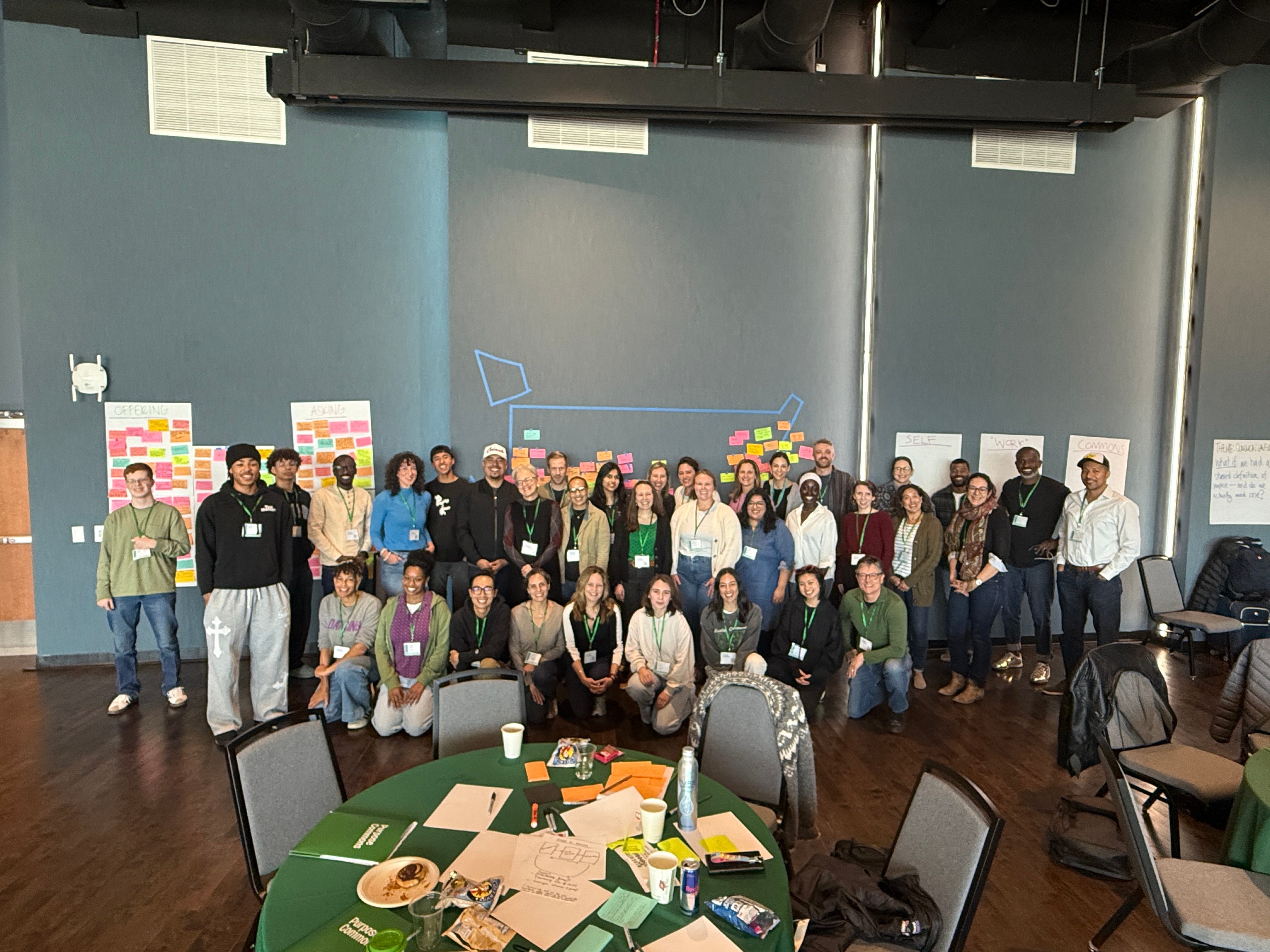
What happened in that room was something special. You could feel it. Around 80 people from across the country (youth, researchers, funders, innovators, and youth-serving organization leaders) came together to explore what it really means to support purpose cultivation.
Now that I’ve had a little time to breathe, the next natural questions are: What do we make of all we heard and learned? And how do we make good on our commitment to co-design a purpose ecosystem in a meaningful way?
These are my initial reflections, an early attempt to make sense of what emerged. Our team is still diving deep into the materials, notes, and feedback from the Jam, and we’ll share a fuller synthesis soon. But as I look back right now, there are a few things that are really sticking out to me.
What We Heard
1. How Do We Build the Commons?
One of the strongest themes was a curiosity about the Commons itself.
Participants asked: What is the Commons? How can I engage? How is it different from a coalition or collective?
That told us something important: people are ready. They care about this work and want to be part of it; they’re just looking for the “how.” So one of our next big steps is to co-create what the Commons will be with the field.
Based on the conversations I had with folks at the Jam, my intuition tells me this is going to look distinctly different from a traditional coalition or collective practice. The Commons is a shared infrastructure for maintaining an idea that belongs to everyone. A living ecosystem that supports purpose cultivation across communities and systems. Now that we’ve seen the level of energy and excitement, we can begin shaping that structure together.
2. What Kind of World Are We Trying to Create?
Another current running through the Jam was aspiration, a vision for what could be.
People reflected on what needs to change in the world so that purpose cultivation is supported by every system and community young people navigate. They named the conditions they want to see: belonging, equity, exploration, safety, access, and communities where youth can be known and grow.
These reflections give us a North Star: the collective vision that purpose isn’t an individual achievement but a shared condition we can create together. The next step is to work with our partners at Purpose Science and Innovation Exchange to gather or create the research to better understand how each of these areas impact purpose development, as well as build deeper relationships with those already doing this work to see where that research can add value.
3. How Do We Measure and Make Meaning of Purpose Cultivation?
Many participants expressed a desire to understand how purpose cultivation can be measured and used to strengthen their work.
Part of the work moving forward will be partnering with organizations that want to measure purpose cultivation, supporting them with what they need to get that ball rolling, while also building an infrastructure that helps organizations identify and leverage the measures that best align with their programs.
The National Purpose Survey is our first attempt to capture the state of purpose cultivation in young people nationwide. (More on the National Purpose Survey below.)
The survey will help identify what measures work, where inconsistencies exist, and how we can better support youth-serving organizations that want to track and grow purpose within their communities.
It’s about building shared capacity for learning, not just collecting data.
4. Insights from Exploration and Identity
We chose to focus on exploration and identity & lived experience as our core themes at the Jam because they emerged directly from our earlier design-research process (you can read more about that in our Design Research Report here.
Through dialogue prompts and storytelling, these themes sparked some of the most personal and thought-provoking conversations of the convening.
On exploration, people wondered:
How does exploration actually contribute to purpose cultivation?
What systems and structures enable or limit it?
Are there “constructive constraints” or boundaries that support, rather than stifle, purpose development?
These questions tell me that the field is sees the value in creating environments where young people can safely explore and where that exploration is recognized as essential to cultivating purpose.
On identity and lived experience, participants reflected on how culture, community, and personal history shape their sense of purpose. They asked:
What makes some life experiences catalysts for purpose cultivation while others fade quietly?
How does identity sustain purpose over time?
How do different cultures talk about and nurture purpose?
We also heard some unexpected but powerful insights like the importance of third spaces (places beyond home and work where reflection and connection happen) and the ways purpose can be felt in the body. People described how their physical presence changes when they feel aligned with what matters most. These are the kinds of discoveries that make building in public so worth it. You can’t predict them. You just have to create the conditions for them to appear.
These reflections are just the tip of the iceberg, early signals of where we might dig deeper through future research, design teams, and community collaboration.
Where We Need To Be Careful
Another thread of conversation has been sitting with me. Several people raised an important question: how do we safeguard this movement for purpose cultivation so that it remains grounded, ethical, and liberatory?
History gives us examples of how the human need for purpose has sometimes been leveraged for harmful or self-serving ends, movements or systems that rallied people around a “sense of purpose” but in ways that excluded, exploited, or harmed others. Participants reminded us that systems the wish to cultivate purpose can have a shadow side if we are not insistent on maintaining our curiosity and collective design principles.
We also talked about thresholds, the balance that exist across all of the themes we’re studying.
What might be “too much” contribution, when giving turns into burnout or loss of self?
What might be “too much” exploration, when endless options create paralysis or privilege only those with time and access to explore?
Is it possible to over-index on identity or personal narrative, to the point where we lose connection to shared or collective purpose?
And who decides what purposes are “good” or “bad”?
These questions don’t have easy answers, but they point to something essential: when we study purpose cultivation, we have to understand not just the benefits, but also the boundaries.
We can’t go into this work bright-eyed and naïve. Our goal isn’t to prescribe purpose for anyone. The goal is to understand the conditions that help people cultivate it authentically and sustainably. That means studying where balance lives: the thresholds between freedom and focus, individuality and interdependence, measurement and meaning.
As we build the Commons and launch new research, we’ll need to carry this awareness with us.
Where We Go From Here
1. Co-Designing the Commons
Over the coming months, we’ll invite Purpose Jam participants and partners to help define what the Commons looks like and how it functions. Is it digital? In-person? A living ecosystem of both? What needs to live there for people to find value and contribute?
The goal is to build a space that helps people connect, learn from one another, and steward purpose cultivation as a public good.
2. Launching Design Teams
In 2026, we’ll launch design teams focused on the two themes that generated the richest curiosity: exploration and identity & lived experience. Each team will bring together youth, researchers, practitioners, and beyond to co-design our next national research projects that blend academic rigor with community wisdom.
The exciting part is that we’re standing at the ground floor of what has the potential to be a game-changing research agenda. If we do this partnership right, it could spark national attention and impact much like the Contribution Project did. You can read more about that ripple effect here.
3. Translating and Connecting the Research
Alongside PSiX at Cornell, we’ll map existing academic research to the questions raised at the Jam identifying where strong evidence already exists and where the gaps remain.
Some of the wonderings participants shared do already have academic work behind them. The goal is to identify those overlaps and prioritize translating and communicating those findings first as a tangible way to demonstrate responsiveness to the field while we continue to build new research pathways.
National Purpose Survey
We’ve also learned that people are just as interested in the process of research as in the results.
The National Purpose Survey is designed to be a broad foundation and a conversation starter, not a closer. Once we receive the initial findings, we’ll work to translate them into regional contexts, building on the national base to explore local realities. Together with community partners, we’ll identify where to dive deeper, where assets already exist, and how to connect the threads across regions.
We also saw how the Jam helped bridge different perspectives in real time. That cross-perspective learning (between researchers, funders, youth, and practitioners) is helping us understand what it truly takes to co-design academic research with community. It’s teaching us how to build research that serves the people it studies (and vice versa).
This is how we turn data into dialogue, and dialogue into shared action that supports purpose cultivation
The Real Test
If the Purpose Jam was about coming together, the next chapter is about staying together.
The true test of its success won’t be how good it felt (though it felt incredible) but what we build next, together.
These are early reflections. We’ll share a more comprehensive synthesis soon. For now, I just want to say thank you to everybody who took the time to Jam with us, to the team that made it possible, and to everyone who continues to believe that purpose is worth cultivating.
The Purpose Jam wasn’t the end of something. It was a collective planting of a seed.
 | A guest post by
|